
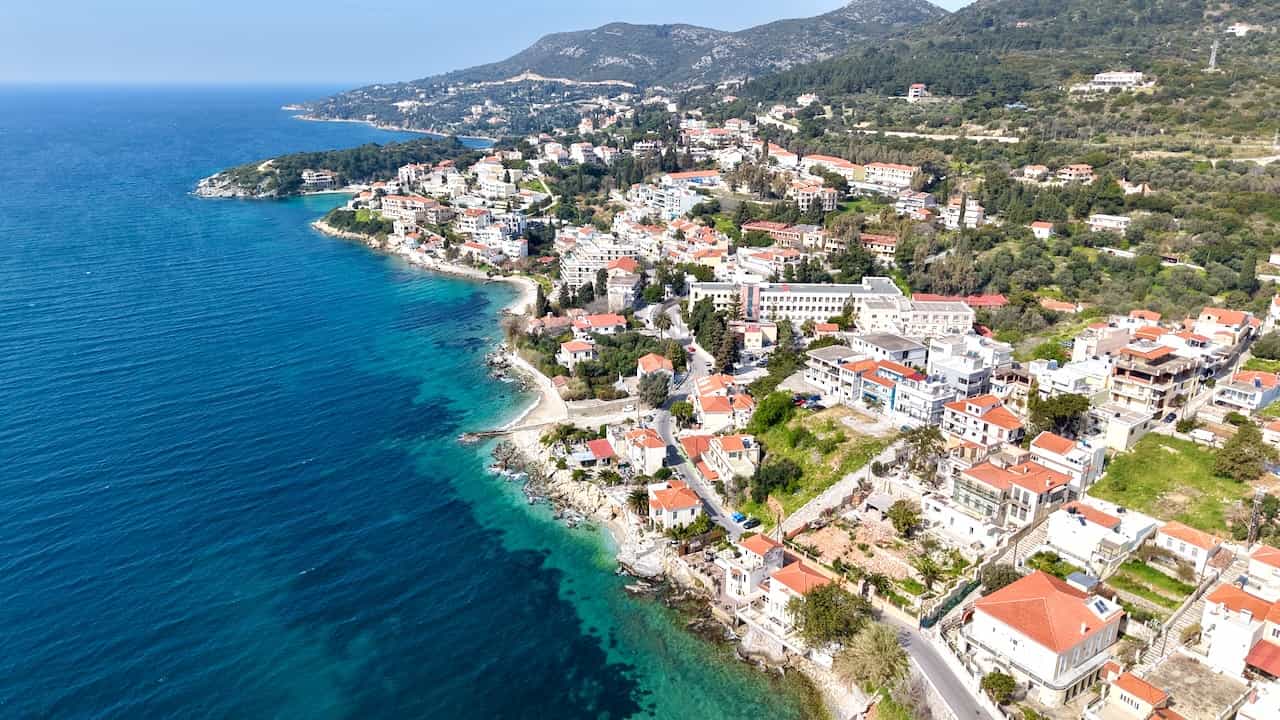
Samos Island.
Naturally captivating.
Pine-covered mountains. Clear Aegean water. Villages with a life of their own. Discover the island we call home.
An island to explore.
A place to belong.
Samos Island, Greece, brings together green mountain slopes, sheltered bays and harbour towns on the eastern side of the Aegean. Follow a coastal road and the scenery changes with every turn: olive groves, vineyards, little churches and the blue of the sea.
We live and work here. This is our introduction to Samos nature, the places worth slowing down for, and a hotel that makes a lovely base for discovering them.
Samos nature, from mountain to sea.
Leave room in your plans for the landscape. Some of the best days on Samos begin with a village walk and end beside the water.
Mountains & forest
Kerkis rises over the west of the island; the slopes of Ampelos, also known as Karvounis, shape its green heart. Woodland paths, hillside villages and open views make Samos much more than a beach destination.
Water & wild corners
Around Potami, near Karlovasi, a wooded stream leads towards the waterfalls. Elsewhere, coastal walks reveal small coves and changing views. Wear suitable shoes and check local conditions before setting out.
Vineyards & olive groves
Terraced vineyards and olive trees are part of everyday island life. Take the slower roads through the countryside, stop in a village square and discover the landscape behind Samos Muscat wine.
Walk early in hot weather, carry water and respect local trail closures and fire restrictions.
Samos beaches & villages.
Kokkari & the north coast
A harbour village framed by beaches, with waterfront cafés and tavernas. Explore nearby Lemonakia and Tsamadou, and choose your swimming spot with the day’s wind in mind.
Samos Town & old Vathi
The island’s capital combines a long waterfront with everyday shops and services. Wander up into old Vathi for narrow lanes and traditional houses, or visit the Archaeological Museum in town.
Pythagoreio & the south coast
Harbour life meets ancient history. Pythagoreio is a natural starting point for the Tunnel of Eupalinos and the Heraion, with Potokaki and other south-coast beaches nearby.
Karlovasi & Potami
Discover a different side of Samos around Karlovasi, from old industrial buildings and neighbourhoods to Potami beach and the wooded approach to its waterfalls.
Kerveli & the eastern bays
Look east for the sheltered character of Kerveli, Poseidonio and Klima. These small bays invite an unhurried swim and lunch by the water; each has a different feel.
Psili Ammos & Marathokampos
For sand, consider Psili Ammos on the southeast coast. In the southwest, Votsalakia and the Marathokampos area offer long beach stretches beneath the mountain backdrop of Kerkis.
An island with depth.
Ancient ideas. Living history.
Samos is the birthplace of Pythagoras and Aristarchus. The UNESCO-listed Pythagoreion and Heraion connect today’s island with an extraordinary ancient past. Make space for its archaeological sites and museums, as well as its beaches.
Discover the UNESCO sites ↗The taste of Samos.
Muscat vineyards, local olive oil, seasonal produce and tavernas by the sea tell another part of the island’s story. Discover Samian wine through a winery visit or explore METAXA LIKNON in the vineyard landscape. Check opening arrangements before visiting.
Explore METAXA LIKNON ↗When to visit Samos.
Spring
Green hills, wildflowers and walking days. Pack layers and allow for changing weather.
Summer
Long beach days and lively harbours. Start walks early and plan shade into the afternoon.
Autumn
A gentler pace, vineyard landscapes and time outdoors. Rain becomes more likely as the season progresses.
Winter
Everyday island life and quieter villages. Expect cooler, wetter weather and fewer seasonal services.
A few things to know.
Where is Samos Island?
Samos is in the eastern Aegean Sea, close to the coast of Turkey. Samos Town and Karlovasi are its main port towns, while the airport is near Pythagoreio.
Is Samos a good island for nature lovers?
Yes. Mountain landscapes, forest, vineyards, coastal paths and beaches give Samos a varied outdoor character. Choose walks suited to your experience and check the weather and local access conditions.
Where can I stay near Samos Town?
INO Village Hotel is in Kalami, above Samos Town. Its rooms and suites, outdoor pool and dining facilities make it an option for visitors seeking a boutique hotel on Samos. Use the official hotel website for current room details and availability.
Do I need a car to explore Samos?
A car gives you more freedom to combine mountain villages, beaches and different coasts. You can also use taxis and local buses; check current routes and timetables before planning a day around them.
Open our Samos road-trip map
Start with our eastern Samos route: beaches, villages and places to stop along the way. Open the map pins for more detail.
Watch Samos through our lens
A Rock in the Ocean — a film of Samos by Yiannis Paleokastritis.
Samos & Aristarchus.
The birth of heliocentrism.
Long before Copernicus, Aristarchus of Samos proposed that Earth revolves around the Sun. Around 2,300 years ago, this astronomer from Samos gave us the first known heliocentric model: a radical new way to imagine our place in the cosmos.
Aristarchus of Samos is the earliest known proposer of a heliocentric model. In the third century BCE, he put the Sun at the centre of Earth’s orbit and explained the daily appearance of the heavens through Earth’s rotation. His original account is lost, but Archimedes records the Sun-centred hypothesis in The Sand Reckoner. [1, 2]
The heliocentric system: Earth around the Sun
Ancient astronomy: measuring the Sun and Moon
In his surviving work, On the Sizes and Distances of the Sun and Moon, Aristarchus used the half-lit Moon to form a right-angled triangle with Earth and Sun. The method could compare their distances. His numerical estimates were inaccurate, but the ambition was remarkable: turn the sky into a question that mathematics could answer. This work is distinct from his lost heliocentric account. [1, 2]
The world can be questioned.
Nature can be understood.
Across the eastern Aegean, the early Ionian thinkers sought explanations within nature. Thales, Anaximander and Anaximenes in Miletus asked what the world is made of and how it changes. Their answers differed; the lasting contribution was the willingness to offer reasons, debate them and seek an intelligible order. [3]
Aristarchus lived centuries later, in the Hellenistic age. His work belongs to that longer story of Greek inquiry. Ionian thought became one of the foundations of Western philosophy and science—not their only source. Astronomy continued to develop across cultures; scholars in the medieval Islamic world made major advances before Copernicus. [3, 4]
A long history of looking again
- 6th century BCE
Ionian inquiry
The Milesians seek natural explanations.
- 3rd century BCE
Aristarchus of Samos
Earth is placed in orbit around the Sun.
- 1543
Copernicus
De revolutionibus presents a developed mathematical heliocentric system.
Selected milestones, not a continuous chain of direct influence. Dates are not drawn to scale.
Carl Sagan on Aristarchus and heliocentrism.
In “The Backbone of Night”, Sagan brings Aristarchus’s idea to life. In this excerpt, the discussion of Aristarchus begins around 1:21; the Copernicus manuscript reference is at 2:18–2:36.
Watch on YouTube ↗Heliocentrism, astronomy & Samos: your questions
What is heliocentrism?
Heliocentrism is a model in which Earth and the other planets orbit the Sun. Aristarchus’s ancient proposal challenged the idea of a stationary Earth at the centre of the heavens. [1, 2]
Who first proposed the heliocentric system?
Aristarchus of Samos is the earliest known proposer of a heliocentric model, in the third century BCE. Copernicus developed a mathematical heliocentric system published in 1543. [1, 2, 4]
Why does Samos matter to the history of cosmology?
Samos was the birthplace of Aristarchus. His Sun-centred model changed the question of where Earth belongs in the cosmos, making him a pioneering figure in ancient astronomy and the history of cosmological ideas. [1, 2]
There is more to Samos than a beautiful horizon.
There is a tradition of asking what lies beyond it.
Sources & further reading
- University of St Andrews · Aristarchus of Samos ↗
- Thomas Heath · The Copernicus of Antiquity (1920) ↗
- Stanford Encyclopedia of Philosophy · Presocratic Philosophy ↗
- Stanford Encyclopedia of Philosophy · Nicolaus Copernicus ↗
- Owen Gingerich · Did Copernicus Owe a Debt to Aristarchus? (1985, PDF) ↗
- John Baez, UC Riverside · The surviving Copernicus manuscript passage ↗
Original diagrams by Samos Housing. Historical dates are approximate where indicated.
Could Samos become your home?
A holiday is a good beginning. If you are thinking about buying a property, we can help you understand the island’s areas and explore homes that fit the way you want to live.